
Combining technological and cultural change to create a digital future for higher education



Canvas
Find out how Canvas provides equitable access and instructional continuity to every student
The higher education space is discovering that digital transformation is a journey, not a destination. As the sector seeks a balance between traditional and online learning, institutional leaders are tasked with empowering faculty with the skills and competencies to embrace technology-enabled education.
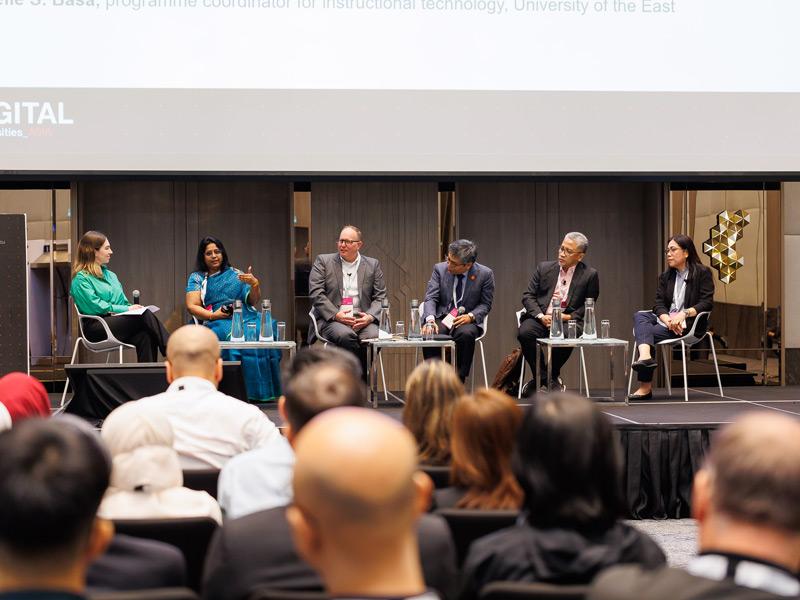
During a discussion at Times Higher Education鈥檚 2023 Digital Universities Asia event, held in partnership with Canvas by Instructure, a panel of experts came together to discuss what is needed to enable genuine digital transformation.
鈥淩ight now, we are looking to standardise our learning to optimise the skill sets of our faculty members,鈥� said Nirmala Menon, head of the School of Humanities and Social Sciences at the Indian Institute of Technology Indore.
鈥淚 think digital transformation can be broken down into stages,鈥� said Charlie Reis, director of the Educational Development Unit at Xi鈥檃n Jiaotong-Liverpool University. 鈥淒igital transformation 1.0 was mostly content. The next stage, 2.0, was more interactive, while 3.0 is looking at using artificial intelligence and other generative functions. Right now, we are looking at all of these stages at the same time because staff boast differing skill levels when using digital technologies.鈥�
To facilitate the use of these digital technologies, some faculty members will need more support than others. 鈥淲e have created an instructional manual for lecturers to facilitate the transition from traditional teaching methods,鈥� said Hieu Hoc Le, dean of the School of Engineering Pedagogy at the Hanoi University of Science and Technology.
鈥淲e did have online classes even prior to the pandemic, but it was on more of a voluntary basis,鈥� Menon said. 鈥淭he pandemic really accelerated this, of course. One of the things we did to streamline this was establishing a robust, smart classroom set-up to make the transition as smooth as possible for academics. Only after they became comfortable did we see faculty embracing greater flexibility with digital deployment.鈥�
Given that digital transformation is an institution-wide process, cross-faculty collaboration has been crucial. 鈥淎t our institution, we got together individuals from different departments to discuss technical and pedagogical changes before they were implemented,鈥� said Rahadian Dadan, vice-rector of academic affairs at Telkom University.
鈥淚 think we can sometimes underestimate the time it takes for course design and delivery,鈥� said Roselle Basa, programme coordinator for instructional technology at the University of the East. 鈥淭his was made especially clear when institutions were managing the transition to digital learning. For us, a learning management system like Canvas was a great help here, handling the administrative tasks so faculty could focus on teaching.鈥�
Of course, as with any change, digital transformation in the higher education space did encounter some resistance. 鈥淪ometimes, there was a feeling of anxiety among faculty members regarding how digital tools should be used,鈥� Le said. 鈥淏ut this was not widespread and largely came as a natural reaction to the pace of technological change being experienced.鈥�
鈥淒igital transformation is also a matter of direction,鈥� Menon said. 鈥淚nstitutions must be clear about what exactly technology brings 鈥� not simply adopt it indiscriminately. This is the best way of minimising resistance and closing skills gaps.鈥�
It鈥檚 also important for universities to understand that digital change is both cultural and technological. 鈥淲ith assessments, we want them to be more authentic,鈥� Reis commented. 鈥淭his has meant being more creative with curriculum design. This is a cultural change that has, of course, been influenced by technology. They are both important factors to pursuing digital transformation and ensuring faculty have the skills required to facilitate it.鈥�
The panel:
- Roselle Basa, programme coordinator for instructional technology, University of the East
- Charlotte Coles, director of global events, Times Higher Education (chair)
- Rahadian Dadan, vice-rector of academic affairs, Telkom University
- Hieu Hoc Le, dean of the School of Engineering Pedagogy, Hanoi University of Science and Technology
- Nirmala Menon, head of the School of Humanities and Social Sciences, Indian Institute of Technology Indore
- Charlie Reis, director of the Educational Development Unit, Xi鈥檃n Jiaotong-Liverpool University
about Canvas.
