
Empowering early-career researchers to take intellectual curiosity to grand challenges


Interdisciplinarity
Sponsored by
Advice for bringing together multiple academic disciplines into one project or approach, examples of interdisciplinary collaboration done well and how to put interdisciplinarity into practice in research, teaching, leadership and impact

You may also like
Interdisciplinarity
Sponsored by
Advice for bringing together multiple academic disciplines into one project or approach, examples of interdisciplinary collaboration done well and how to put interdisciplinarity into practice in research, teaching, leadership and impact
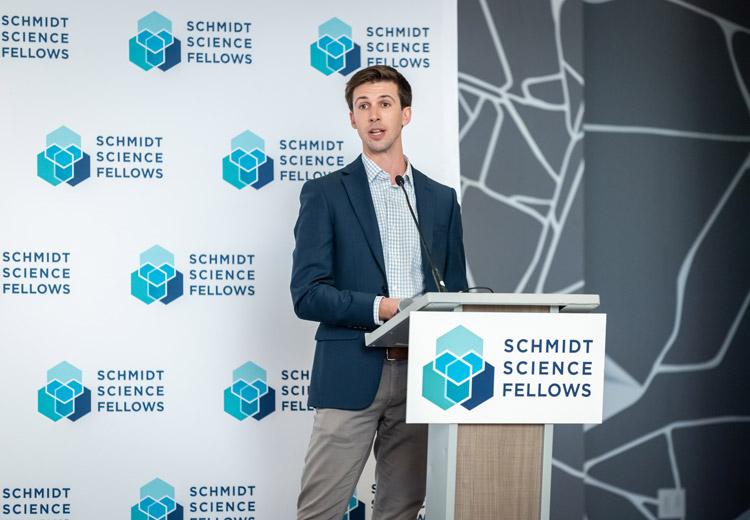
Intellectual curiosity is what animates scientists to do what they do 鈥� to dig deeper and ask the big questions. It does not heed disciplinary boundaries, and so, when those big questions take a scientist to the edge of their expertise, they must decide whether to follow their curiosity over it. Moving into new fields to translate biological insights into new robot capabilities is exactly how Ryan Truby, a biomedical engineer by undergraduate training, ended up at Northwestern University as an assistant professor in the Department of Materials Science and Engineering and the Department of Mechanical Engineering.
A synopsis of Truby鈥檚 recent grants reads with the air of science fiction, spanning artificial muscle tissues for locomotion in soft machines to robotic architected materials with distributed sensorimotor capabilities. Truby鈥檚 research is centred on bridging the gap between living organisms and their capabilities and the world of robotics. It resides at the interface of materials engineering and robotics.
鈥淲e have a wealth of understanding about how the human body 鈥� or any living organism 鈥� works, how it is built and what materials comprise it,鈥� he says. 鈥淲e can look at robotics and quickly see that some of these insights might help us advance machine intelligence in new and critical ways. This is the problem space my lifelong curiosities have brought me to, taking those insights from biology and thinking about how I can translate them to advance the capabilities of robots. My hope is that the journey ahead will enable us to materialise true autonomy, true intelligence, in ways that computational approaches alone simply can鈥檛.鈥�
Truby made his pivot to materials science as a PhD student at Harvard University, where he found the intellectual breathing space to explore the construction of bioinspired robots and devices from soft matter. He notes it was a time when he first felt the tension between disciplinary focus and the interdisciplinary nature of his scientific interests.
Truby鈥檚 PhD advisor, Jennifer Lewis, helped him through. 鈥淛ennifer has become such a role model. Looking back, all my lab mates from those years are still among the most talented people I know. She had a way of bringing us together, with all our different backgrounds, to build a research team that was able to work on a variety of problems at the intersections of many fields,鈥� Truby says. Being offered a Schmidt Science Fellowship, however, was 鈥渆ssential鈥�, offering him similarly inspiring mentorship but on a systemic scale 鈥� and with funding. 鈥淭he Schmidt Science Fellowship completely changed my reality,鈥� he says. 鈥淚t gave me a sense of agency to run straight into working in robotics as a materials engineer.鈥�
Truby says he would love to see a research ecosystem that funds PhD students and postdoctoral researchers directly 鈥� a partial inversion of the current funding landscape that allows researchers at the earliest career stage to more directly take part in the formulation of interdisciplinary research projects aimed at solving major challenges. 鈥淭he Schmidt Science Fellowship empowered me with the freedom to take a line of interdisciplinary enquiry in my research. I can only imagine the impact others could have and how quickly we could advance interdisciplinary science if they were given that same support and independence,鈥� he says.
Inevitably, it will be Truby鈥檚 students who are designing solutions for tomorrow鈥檚 world. The current PhD students and postdoctoral scholars in his lab are already investigating how soft robotic materials can be deployed in areas such as sustainability and healthcare settings. It is all interdisciplinary, intellectual curiosity set loose.
Times Higher Education has partnered with Schmidt Science Fellows to develop a new ranking measuring universities鈥� contribution to interdisciplinary science.
about Schmidt Science Fellows.
