
Let’s seriously game higher education to tackle the challenges ahead


You may also like
The role of higher education is to build up knowledge, learning, development and the skills to tackle what can be considered the “tomorrow problems�, such as the ageing demographic or climate change. Students, professionals and the wider public often find these topics intangible, invisible or outside their reach. This makes it
We have found serious gaming to be one of the most powerful solutions to helping students, professionals and the wider public personalise, learn and think through how we future-proof society. It helps to tap into that important negotiation C. Wright Mills outlines in The Sociological Imagination around the complex interplay between agency and structure. With a serious game methodology, you can help to make the intangible tangible and play into future-facing scenarios for solutions to the tomorrow problems at individual and structural levels.
What is a ?
Serious games can be diverse, but we use practical and face-to-face methods, mainly using table-top, board-game style mechanisms. These are a basis to play out facilitated scenarios to explore problems and solutions that support innovative and creative thinking. It is a and we have found serious gaming to be at its best when combined with research evidence, integrating lived experience scenarios and co-produced with professionals and the public to support insight into real-world experience.
It is a serious topic, but people are allowed to have fun!
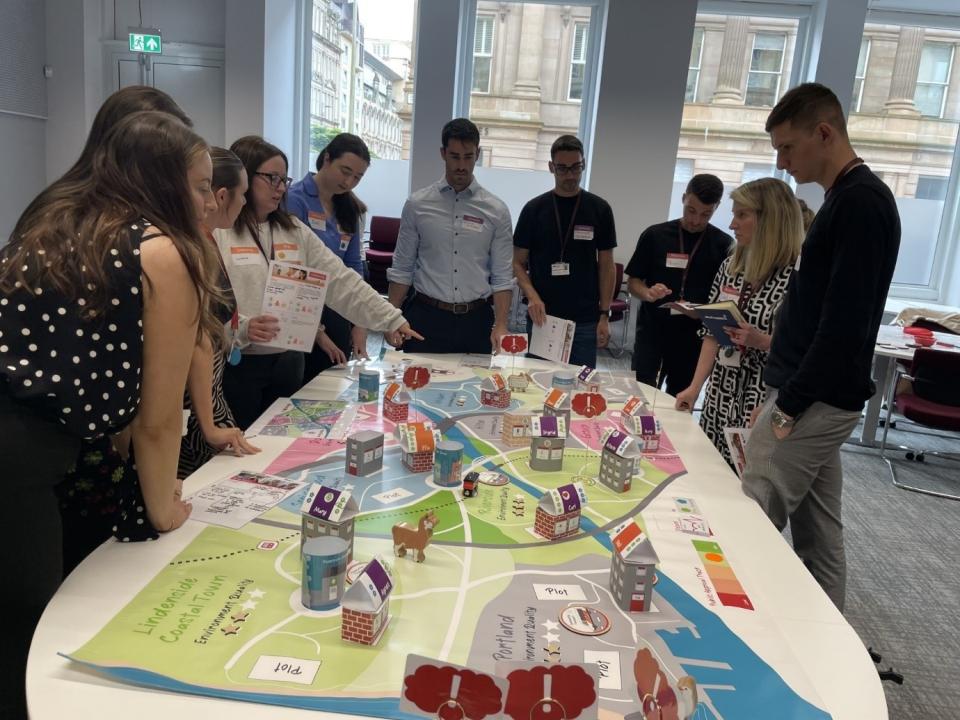
For example, to help understand how we prepare the housing, health and social care sectors for the ageing demographic, my colleague , chair in social statistics, and I developed . In Hopetown, we split the classroom into four teams (developers, policymakers, service providers, community) with different objectives, but they must come together to improve the well-being of the people in Hopetown.
- Spotlight guide: É«ºÐÖ±²¥ Awards 2024: learn from the best in UK and Irish higher education
- Next level? The pros and cons of game-based learning
- Let’s play! Using games to teach statistics and economics
This encourages systems thinking, exploring how housing, health and social care must work together, how you build homes and develop services. You add challenges such as reducing budgets to see what people prioritise, or more people can be added to the board to mirror diverse support needs and an ageing population. This allows insight into planning for the future, because students are faced with the consequences of their decisions by playing the serious game – bringing the tomorrow problems to life!
Why engage in serious play?
Using physical maps, markers and wider gaming elements helps to support engagement, immersion and roleplay. This can increase understanding of the barriers faced by both individuals and others, and build understanding and empathy. See it in action here in this video: . Also, as educators delivering and facilitating, it is a real joy to see students, professionals and others immerse themselves in the serious play experience and begin to join the dots.
At the moment, serious games such as , a game designed to explore adaptations as part of the Designing É«ºÐÖ±²¥s for Healthy Cognitive Ageing (DesHCA) project are being across the life course. Hopetown has also been by the . The approach has been so popular that there has been beyond higher education from the housing, health and social care sectors and beyond for professional development.
The key benefits of serious gaming:
- Serious games provide an excellent way of combining research insights, teaching, learning and development.
- supports strategic, creative thinking and decision-making.
- Gaming mechanisms support student engagement with diverse and complex topics
- Serious games lead to high levels of interaction, communication and collaboration.
- Serious games help overcome “� and personalise wider challenges.
- Serious games can cross , and give insight into the importance of partnership working.
- Interactive and immersive roleplay is fun for those playing and delivering serious games.
Overall, we must think more creatively in higher education about how we engage students with the larger societal challenges facing us on a human and global level – or, as C. Wright Mills would argue, help people to find their sociological imaginations and go beyond those “personal troubles� to understanding them as “public issues�. We have found that using serious game methodologies can join the dots to systemic and critical engagement with wider challenges, such as planning for the ageing demographic and climate change.
Also, as a bonus, it is fun to both play and deliver as educators. We highly recommend serious games as a core way to engage with the tomorrow problems!
Vikki McCall is professor of social policy at the University of Stirling. She was shortlisted in the Most Innovative Teacher of the Year category in the 2024 É«ºÐÖ±²¥ Awards. A full list of nominees can be found .
If you would like advice and insight from academics and university staff delivered direct to your inbox each week, .
