
School Tasking: forget explosions, it鈥檚 all about the skills


You may also like
Popular resources
Children aged from nine to 10 years old can be better at legal reasoning than law students. At this age, they remain unconstrained by concern about what the law is or what the lecturer at the front of the room is expecting them to say. They answer honestly, logically, usually rationally and, perhaps most importantly, with the innate sense of justice and fairness that children of this age tend to possess.
Here鈥檚 an example from , the university-led outreach project that started life at Warwick Law School and is now running at 30 universities (and counting) across the UK and Ireland. Classes discuss a real case in which the respondent argued that a tax applying to all vehicles 鈥渙n the road鈥� certainly didn鈥檛 apply to his car, which he had lifted up and placed on roller skates. The car, he claimed, wasn鈥檛 on the road; it was on roller skates, obviously. During a School Tasking session, a Year 5 girl put up her hand and proclaimed: 鈥淏ut if you were a person on the road on roller skates, you鈥檇 still be on the road.鈥� Beautiful, logical and simple reasoning that wasn鈥檛 mentioned in the case but, one might suggest, ought to have been.
- Spotlight guide: 色盒直播 Awards 2024: learn from the best in UK and Irish higher education
- Opinion: academics can (and should) be idiots
- Key questions to help universities measure societal impact
Reasoning skills tend not to be honed to a great extent within formal schooling, and certainly not legal reasoning skills with children as young as Year 5. Yet they arguably provide a crucial foundation for other skills, including problem-solving and critical and lateral thinking. School Tasking sets out to foster these skills, and others, by introducing children from schools in less-advantaged areas to the most interesting, contentious and curious aspects of law, while also building broader positive connections with higher education. The success of the project has shown that outreach based around skills and interactivity can be dynamic, innovative and, perhaps most importantly, an awful lot of fun.
Even if you haven鈥檛 considered it before, the beloved and idiosyncratic television show is actually all about law: people following written instructions, debating the meaning of the words in those instructions and then trying to convince an often sceptical judge that the meaning they have ascribed to the words is, indeed, the correct one. This, of itself, made the show a natural candidate for engaging legal outreach.
But Taskmaster is also wonderfully inclusive and, when this is translated into the classroom, it enables the contribution and success of pupils with varied skillsets. It is not always the academic team members who excel, nor is it exclusively the creative children, the talented orators or the gifted problem-solvers. The tasks are designed to speak to a broad spectrum of skills, with the aim of encouraging all children to contribute to their teams and share in their success.
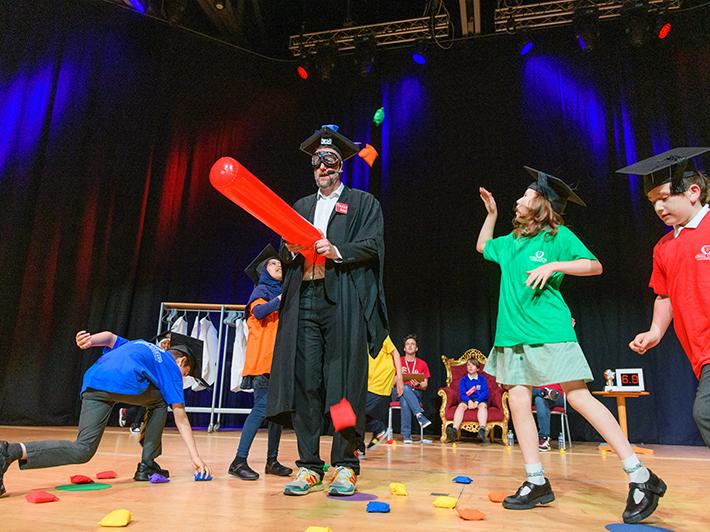
borrows the format of Taskmaster to transform legal outreach into an interactive and inclusive competition, where Year 5 teams compete against their classmates, schoolmates, other schools in their university competition, other universities in their regions (if they make it to the ) and, ultimately, the winners from each of the six regional finals (if they make it to the grand final). At each stage, School Tasking becomes less traditionally educational. The in-school sessions involve learning about law and practising legal skills in an interactive way. The regional finals include tasks with Lego, biscuits, needle-felted Little Alex Hornes (who, for the uninitiated, is the creator of Taskmaster) and so on, largely for the joy of it but with a connection to law. By the grand final, children are simply larking about doing nonsensical tasks with Alex on stage in front of an audience of around 1,000 people. This is deliberate. We are aiming to introduce children to law and to encourage positive connections with higher education. By the time of the champion of champions competition, the latter goal becomes our exclusive focus.
This is where School Tasking might offer a blueprint for other disciplines. It can be challenging for outreach in the humanities and social sciences to compete with the instantly awe-inspiring explosions and colour-changing chemical reactions of the sciences, but School Tasking has shown that where outreach is designed to be joyful, inclusive and, in this case, supportively competitive, children can be just as engaged. When outreach focuses on the skills that children gain, rather than attempting to distil university-level knowledge about a subject into a short classroom session, it is not only more impactful but, ultimately, more enjoyable, too.
And, indeed, you might be surprised at just how proficient young children are when given the chance to practise complex skills such as reasoning and critical thinking. At one time, a task in the project was worded like this:
. Your poster can include up to 30 words.
A Year 5 said to Ali: 鈥淪o my poster can include more than 30 words?鈥�
鈥淎ll the information is on the task鈥� was, of course, the standard response.
鈥淲ell, it says 鈥�can include鈥�. My poster can include a giraffe, but it doesn鈥檛 have to.鈥�
Children are considerably more competent than they are often given credit for. Outreach can, and should, be the vehicle that enables them to shine.
Oh, and the task now reads: 鈥淵our poster must not include more than 30 words.鈥�
Ali Struthers is a reader at Warwick Law School, director of widening participation and creator of School Tasking at the University of Warwick. Alex Horne is the star and creator of Taskmaster.
The University of Warwick was shortlisted in the Widening Participation or Outreach Initiative of the Year category in the 2024 色盒直播 Awards. A full list of nominees can be found .
