
What does the future hold for the university campus?




EAB
Find out how EAB meets the unique needs of every leadership team, as well as the students and employees they serve
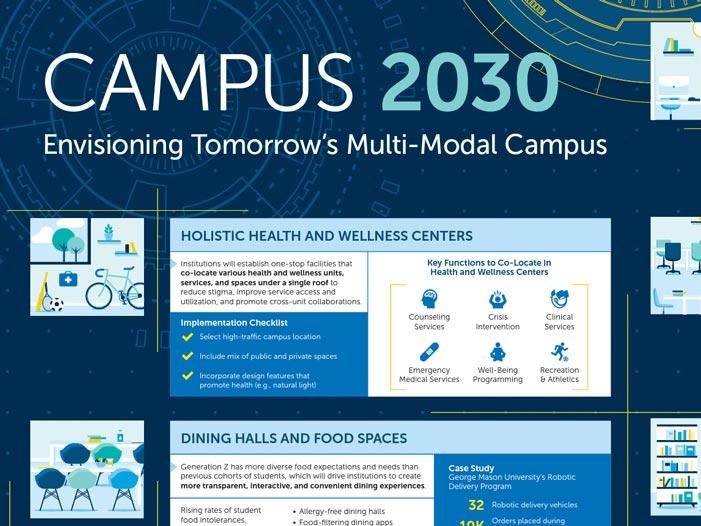
Universities are not just changing in terms of what they teach 鈥� physical campuses are also evolving at pace, accelerated by the impact of the pandemic and changing student expectations. To reflect this, education insights specialist EAB has produced an infographic of Campus 2030, showcasing the key ways university campuses will evolve by the end of this decade.
Office spaces are the element of campus life that have seen the greatest change, according to Michael Fischer, a director of research at EAB. 鈥淯niversities beginning hybrid work practices now have a lot of offices that are underutilised and take up valuable real estate, so they鈥檙e a good place to start,鈥� he explains.
The number of non-academic staff working remotely some of the time has increased four-fold since the pandemic and is expected to grow further by 2030, so it will become more important to offer dynamic and social collaborative office spaces for when staff are on campus.
The University of Leicester has piloted a WorkSmart model that makes use of four different types of space for agile working, and an employee to desk ratio of 2:1. It has reduced operating costs by 拢180,000 in the first year as a result.
Classrooms are increasingly multimodal spaces that can easily pivot from one type of use to another. With more lectures taking place virtually since the pandemic, lecture spaces will need to be more intimate and engaging to facilitate discussions, while tools such as ceiling-mounted microphones and upgraded cameras will make it easier for remote and in-person attendees to collaborate. 鈥淲e鈥檒l see more focus on automating these changes so it鈥檚 as seamless as possible for staff and students, rather than having to call in estates teams to adapt the space rapidly,鈥� adds Fischer.
The ongoing shift to more interdisciplinary research will influence laboratory and other academic spaces. While universities will continue to invest in subject-specific equipment, there will be a greater focus on the environment that surrounds that research.
鈥淚t will be less about the lab itself and more about how you bring people together, the interactive environment where they linger for conversations,鈥� Fischer says. Examples of such spaces are appealing cafeterias or wider corridors with lots of natural light that draw people together. Libraries and learning commons will see a similar evolution in terms of enhancing the student experience, with institutions increasingly leveraging data to build insights on how to create the most valuable space for users.
Student life has changed dramatically since the pandemic, and facilities such as health centres, accommodation and dining halls will shift to meet new expectations, Fischer says. Well-being centres are increasingly central facilities where students can gain support on physical and mental health, attend fitness classes and speak to professionals free from stigma.
There will also be innovation in dining services, with more options available to students and greater transparency around what they鈥檙e buying. At one cafe at the University of British Columbia three price points are offered for the same meal, so students can either pay full price, pay a subsidised price or pay it forward, the latter of which covers the cost of the subsidised meal.
Meanwhile, the focus of accommodation will grow around socialising, creating common areas that bring students together. Crucially, none of these developments will happen in isolation, concludes Fischer. 鈥淲e have to think about how all these spaces work together rather than as separate entities with their own fiefdoms and principles,鈥� he says.
the Campus 2030 Infographic.
