
Designing courses that prioritise student experience and transform employability



QA Higher Education
Learn how QA Higher Education works with partner universities to provide excellent teaching in locations around the UK
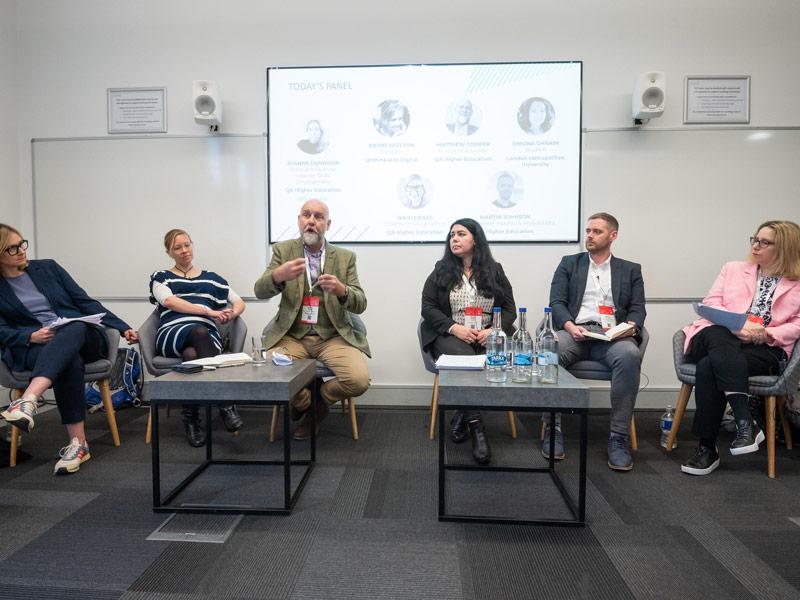
At the 2024 色盒直播 Digital Universities UK event, leaders from QA Higher Education participated in two panel sessions that brought together a diverse selection of speakers from academia, digital strategy and careers.
One panel, which was hosted by QA Higher Education, discussed methods of harmonising human and digital interventions to transform student employability. 鈥淎s part of a survey of prospective students held by QA Higher Education last year, increasing salary was both the most common and most important motivation behind further study according to respondents,鈥� explained Joanne Dennison, associate dean for learner skills development at QA Higher Education. 鈥淭his was closely followed by increasing employability.鈥�
鈥淲hen students are choosing a university, we found some really interesting statistics,鈥� Martin Johnson, head of market insights and portfolio at QA Higher Education, added. 鈥淎n overwhelming 90 per cent said they looked for staff with industry experience.鈥�
Evidently, students expect their university experience to allow them to forge and strengthen industry connections. 鈥淭his includes through internships, cooperative programmes and research projects that align with student career goals,鈥� said Simona Chraim, a business management student at QA Higher Education in partnership with London Metropolitan University. 鈥淭hey also value resources for skill development.鈥� This is something that Matthew Cooper, programme leader at QA Higher Education was keen to reinforce. 鈥淚 think the two keywords here are currency and accessibility,鈥� he said.
On the technical side, further research indicates that younger people want additional help and support regarding the practicalities of finding and applying for jobs. 鈥淥ne thing we were interested to find is that people were specifically looking for ways that AI could help with this,鈥� said Kathryn Skelton, director at Unthinkable, an agency for the creation of digital experiences that inspire, entertain, teach and enable people to connect. 鈥淎t the same time, the young people that we spoke to were thinking very holistically about their job opportunities and prospective careers.鈥�
鈥淎dditional tools are really just the wrappers around the services you鈥檙e providing,鈥� said Nikki Drake, chief technology officer at QA Higher Education. 鈥淚t鈥檚 still important that students can articulate the skills they鈥檙e learning and express those to an employer.鈥�
In a separate panel discussion focusing on immersive block teaching models, the importance of aligning tech and human interventions shone through. These models have taken different forms at institutions, with Susan Orr, pro vice-chancellor for education and equalities at De Montfort University, explaining that her institution took a very proactive approach to programme management.
鈥淲e looked very carefully at the various strands that underpinned block teaching,鈥� Orr said. 鈥淭his included strands like student record systems, student regulation and marketing. There was a well thought through change programme.鈥�
At Plymouth Marjon University, meanwhile, Debby Cotton, dean of the Doctoral College, explained that the institution is employing a blended approach that involves some block teaching alongside more traditional pedagogical approaches. 鈥淎 lot is really about curriculum design,鈥� she said. 鈥淲e did experience some pushback but it鈥檚 really about upskilling people in good curriculum design.鈥�
鈥淵ou have to tailor to the audience,鈥� Dennison added. 鈥淲hether that means students need block scheduling or want the experience of living away from home for the first time, you have to cater for both.鈥� Whether this means block teaching will be adopted wholesale by the sector, a demand for universities to embed employability within the fabric of the student experience will surely continue to be a factor. It鈥檚 all about meeting student demand 鈥� that was evident across both panels.
The panels:
Harmonising human and digital interventions to transform employability
- Simona Chraim, business management student, QA Higher Education
- Matthew Cooper, programme leader, QA Higher Education
- Joanne Dennison, associate dean for learner skills development, QA Higher Education
- Nikki Drake, chief technology officer, QA Higher Education
- Martin Johnson, head of market insights and portfolio, QA Higher Education
- Kathryn Skelton, director, Unthinkable
Will immersive block teaching models become the norm in UK universities?
- Debby Cotton, dean, Doctoral College, Plymouth Marjon University
- Joanne Dennison, associate dean for learner skills development, QA Higher Education
- Susan Orr, pro vice-chancellor for education and equalities, De Montfort University
- Roscoe Hastings, director of teaching excellence and enhancement, University of Exeter
.
