
Covid should have taught us that campus needs to be a treasured space


You may also like
Popular resources
In March 2020, the World Health Organisation declared a pandemic. Unprecedented public health strategies were taken across the world, including introducing the Coronavirus Act 2020 in the UK, . During the policing of this public health emergency, citizens saw previously everyday acts being criminalised 鈥� socialising with friends, for example. This response to the pandemic could be characterised as 鈥渁nti-community鈥�, with students finding themselves locked down and socially isolated 鈥� many in cities they had never visited before. Students were also told to stay away from campus.
One of the key impacts of Covid-19 on higher education has been the unprecedented mass migration from conventional, face-to-face lectures to online teaching, . This move clearly affected students鈥� feelings of belonging, as the physical space of campus was no longer welcoming for the students or staff.
- Resource collection: The post-pandemic university: how to serve the Covid generation
- The campus is dead, long live the campus
- Open to all? Using our physical and digital spaces to better engage local communities
As we move into the 鈥減ost-disaster鈥� stage of the pandemic, it鈥檚 important that we acknowledge and recognise that 鈥溾��. Indeed, students must have the opportunity to co-create, co-construct and collaborate within the campus, allowing for the creation of a 鈥渟ense of place鈥� that any good campus should be.
Hilda Mulrooney and Alison Kelly note that , finding that 94 per cent of respondents agreed that campus space mattered to them.
And, of course, as a response to returning to 鈥渘ormal鈥�, universities are now imploring students: 鈥淐ome back!鈥�
They have been surprised by the slow uptake. But is this surprising? The rhetoric for almost two years was something along the lines of: 鈥淕o away. You are 鈥榙iseased鈥�, and we don鈥檛 want you on campus.鈥� It doesn鈥檛 seem a stretch to think this might have a lasting impact.
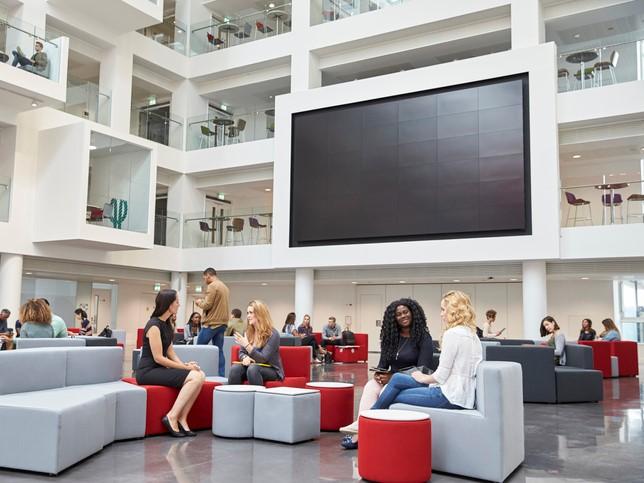
The creation of 鈥渢reasured spaces鈥� on campus has yet to happen. They clearly have not yet become safe places where students feel like they belong. The term 鈥渢reasured spaces鈥� here embodies the unique sense of identity, community and belonging that students experience when gathering together in person. These are the moments and places they will remember long after they graduate.
Educational spaces for students their sense of belonging, social components, intrinsic motivation, retention and, ultimately, educational outcomes. Therefore, offering impactful, valuable spaces to students to co-create a positive experience is likely needed more than ever in a post-disaster era.
It is, after all, within the physical space that human touch occurs. People are social, and many of our in-person interactions cannot be replicated in the digital sphere. While digital spaces and hybrid learning remain a crucial tool for equity, diversity and inclusion concerns, it鈥檚 crucial that students are presented with safe spaces on campus to meet others, build friendships to develop collegiate relations. The same goes for staff, many of whom found the rapid transition to online emotional, stressful and difficult.
As such, the value of the physical campus needs to be much more clearly communicated to stay-away students. Yes, the online environment allows for welcome escapism during difficult times, but the physical space provides solid experiences where (arguably) the most meaningful relationships can be built.
Perhaps we now realise more than ever that the physical space of the campus is not neutral. The creation of treasured moments, of human social touch, is vital for the student experience. Moving forward, as we tend to the scars of lockdown, universities need to create memorable spaces with different facets. There must be learning spaces, of course, but also inviting spaces for engagement (pool tables to use while students wait for their next class, perhaps), physical-digital spaces (for example, the ability to make digital connections and join in online learning while students physically sit beside their friends) and added ability and incentive to drop into the student support office or an academic鈥檚 office to ask questions or even just say 鈥渉i鈥�.
Students鈥� most memorable moments at university are invariably those in which they engaged fully, when they shared their lived experiences, when they realised their struggles were not just their own, when sensory experiences took place. It鈥檚 these moments we need to bring back for our students. And so often the ability to do so can be a question of space.
Gemma Ahearne is lecturer in criminology and Treasa Kearney is senior lecturer in marketing, both at the University of Liverpool, UK.
